
The NDIS Is Changing – Here’s What WE KNOW
There’s a growing level of uncertainty across the NDIS at the moment, particularly for families and providers in the therapy space.
One of the biggest shifts being discussed is the move toward mandatory registration for providers, designed to improve safety, accountability, and transparency across the scheme.
So what does this actually mean for your child and the providers you work with?
A Key Statistic You Should Be Aware Of
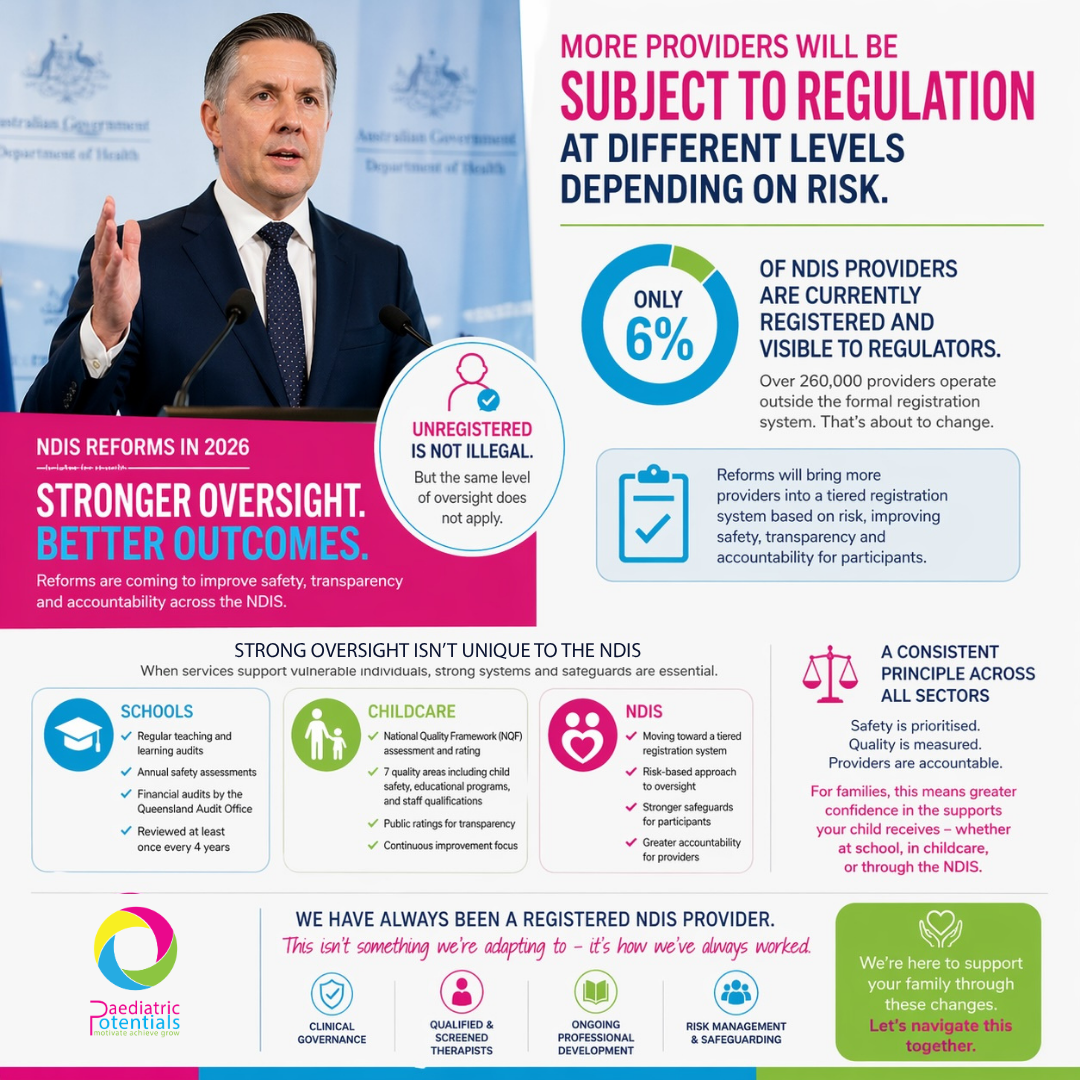
Recent reporting has highlighted that only around 6% of NDIS providers are currently registered and fully visible to regulators.
That means the vast majority - over 260,000 providers - are operating outside the formal registration system.
It’s important to be clear:
Unregistered providers are not doing anything illegal
Many deliver high-quality support
However, they are not subject to the same level of oversight, auditing, and safeguarding requirements
This gap is a major driver behind the proposed reforms.
The Latest Update (April 2026)
In the past week, new reporting has provided further insight into what the final model may look like.
Under a potential framework being considered by the Department of Health, the NDIS registration system would still follow a four-tier structure, but with a more refined, risk-based approach:
Lower-risk supports may fall under a lighter-touch registration model, potentially reducing compliance burden for some providers
A medium-risk tier would introduce more structured oversight
A high-risk tier would require in-depth assessments and stricter regulation
A separate category would apply to mainstream retailers and non-NDIS providers, who would not require registration but would still be visible through improved payment tracking systems
While this model has not yet been formally confirmed, it aligns closely with earlier recommendations and signals a clear direction:
More providers will likely be brought into a regulated framework - just at different levels depending on risk.
We expect further clarity following the NDIS Minister’s address at the National Press Club.
Where Did This Come From? (The 2024 Recommendations)
This approach isn’t new.
Early recommendations released in 2024 first proposed a tiered registration system, where requirements vary depending on:
The risk level of the support provided
The level of interaction with the participant
While the final model may evolve, these recommendations provide a helpful foundation for understanding what’s likely ahead.
What the Tiered System Could Look Like
Based on both the 2024 recommendations and current updates, the system would likely resemble:
Tier 0 – No Registration (Retail / Goods)
Applies to purchases like equipment or consumables
No direct support provided
Visibility maintained through payment systems
Tier 1 – Light-Touch Registration (Low Risk)
Lower-risk supports
Basic complaints and incident processes
Reduced compliance burden
Tier 2 – Moderate Registration
Increased oversight and structure
Likely applies to supports involving more regular interaction
Tier 3 – High-Level Registration
Supports requiring skill, training, and ongoing contact
Includes stronger safeguards such as worker screening, incident reporting, and formal compliance systems
Tier 4 – Advanced / High-Risk Supports
Highest-risk environments
Subject to in-depth assessments and strict regulation
What This Means for Occupational Therapy
Occupational therapy providers are expected to fall within the moderate to higher registration tiers under this model.
This reflects:
The ongoing, direct work with children and families, and
The need for qualified professionals and structured clinical oversight.
Why This Matters for Families
At its core, these changes are about protecting participants and improving quality of care.
When a provider is registered, it typically means they are:
Independently audited
Required to meet national quality standards
Accountable through complaints and incident processes
Operating within a structured safeguarding system
Stronger Oversight Isn’t Unique to the NDIS
While these changes may feel significant, it’s important to recognise that the NDIS is not alone in strengthening oversight.
Across Australia, sectors that support vulnerable populations—particularly children—already operate under structured regulatory frameworks designed to ensure safety, quality, and accountability.
Schools
Queensland state schools undergo a comprehensive program of review and oversight, including:
Regular Teaching and Learning Audits
Annual safety assessments
Financial audits conducted by the Queensland Audit Office (QAO)
These reviews typically occur within a four-year cycle and are designed to ensure:
High-quality education delivery
Safe learning environments
Ongoing improvement
Early Childhood Education & Care
Childcare services operate under the National Quality Framework (NQF), which includes:
Formal assessment and rating processes
Evaluation against seven quality areas, including:
Child safety
Educational programs
Staff qualifications and training
Publicly available ratings, providing transparency for families
This system supports continuous improvement while giving parents confidence in the quality of care.
A Consistent Principle Across All Sectors
When services support vulnerable individuals, strong systems and safeguards are essential.
Rather than being an outlier, the NDIS is moving toward a model that aligns more closely with other sectors where:
Safety is prioritised
Quality is measured
Providers are accountable
For families, this consistency provides greater confidence that the supports their child receives—whether at school, in childcare, or through therapy—are held to high and consistent standards.
Our Commitment at Paediatric Potentials OT
At Paediatric Potentials OT, we have always operated as a fully registered NDIS provider.
We made that decision early—not because it was required for all providers, but because we believe:
Children deserve the highest standard of care
Families deserve confidence and transparency
Strong systems and safeguards should be the baseline—not the exception
Our team meets strict requirements around:
Clinical governance
Therapist qualifications and screening
Ongoing professional development
Risk management and safeguarding
This isn’t something we’re adapting to - it’s how we’ve always worked.
What Should You Do Next?
With further announcements expected, now is a good time to:
Review your current providers
Ask questions about registration and compliance
Understand what safeguards are in place for your child
If you’re unsure what these changes mean for your situation, it’s worth having a conversation.
Final Thoughts
The NDIS is evolving and while change can bring uncertainty, the direction is clear:
Stronger oversight, clearer accountability, and safer supports for participants.
We’ll continue to monitor updates following the Minister’s announcement and keep families informed as more details are confirmed.
Speak With Our Team
If you have any questions or would like to know more about anything we have mentioned in this article, feel free to get in touch and we can point you in the right direction to learn more. You can contact our office on (07) 3186 1390 and speak to one of our friendly team.